
How Georgina Rodríguez Turned a Billboard into a Demand Machine

Most campaigns chase attention. They optimize for impressions, reach, and visibility, assuming that if enough people see something, results will follow. But attention without interaction is passive, and passive attention rarely converts into anything meaningful.
What happened with Soy Georgina Season 2, led by Netflix España, was fundamentally different. This was not a campaign designed to be seen. It was designed to be participated in. And that distinction is where the leverage was created.
The Discomfort
Most brands still treat advertising as a broadcast function. They push messages outward and hope the market responds. But modern audiences are not passive recipients; they are active participants. If your campaign does not give them a role, they will not engage. And if they do not engage, they will not remember.
Visibility alone is no longer a competitive advantage. Participation is.
Proof Block
Research from Nielsen shows that campaigns driven by user-generated content can generate significantly higher engagement and trust compared to traditional brand-led messaging, often outperforming in both recall and conversion metrics.
Source: https://www.nielsen.com
This explains why campaigns that invite action outperform those that simply deliver messages. People trust what they help create.
The Real Problem Is…
Most marketing is built for exposure rather than involvement. It assumes that attention leads to demand, when in reality, demand is created through emotional investment. Without participation, there is no ownership. And without ownership, there is no amplification.
Strategic Reframe
This campaign was not a billboard activation. It was a demand-generation system built on three forces: interactivity, scarcity, and cultural signaling. The billboard was simply the entry point. The real asset was the behavior it triggered.
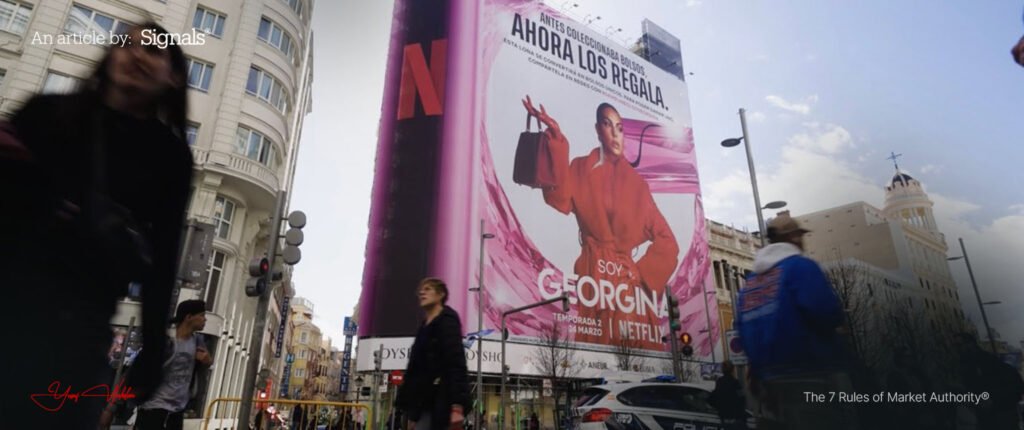
The Mechanisms Behind the Campaign’s Impact
1. Turning a Static Asset into a Behavioral Trigger
Traditional billboards are endpoints; they deliver a message and the interaction ends there. This campaign inverted that model by making the billboard the beginning of an action. By asking people to photograph it, share it, and engage with it socially, the campaign transformed a passive format into an active loop. Every participant became a distributor, extending reach without additional media spend.
2. Scarcity Engineered Desire, Not Just Interest
The decision to turn the billboard into a limited-edition handbag was not a creative gimmick; it was a strategic move rooted in basic economic principles. Scarcity increases perceived value. By making the product finite and unconventional, the campaign elevated it from a promotional item to a collectible. The fact that some of these bags were resold at prices exceeding established luxury brands reinforced this perception, turning attention into tangible economic value.
3. Social Currency Drove Participation
Participation was not just incentivized by the reward but by the status associated with it. Owning a bag made from a viral campaign is not just ownership; it is a signal. It communicates proximity to culture, relevance, and exclusivity. This is what made people want to engage publicly rather than privately. The campaign did not just offer a prize; it offered identity.
4. Multi-Channel Amplification Created Momentum
The campaign did not rely on a single channel. It combined physical presence in Madrid, social media virality, and television exposure to create a feedback loop. Each channel reinforced the other. Social media drove awareness, television legitimized the campaign, and the physical billboard anchored it in reality. This convergence created momentum that no single channel could achieve independently.
5. Narrative Elevated the Campaign Beyond Promotion
The messaging—“Before she collected handbags, now she gives them away”—was not informational; it was narrative-driven. It framed the campaign as a story of transformation and access. This shifted the perception from marketing to moment. People were not just engaging with an ad; they were participating in a cultural event.
Commercial Implication
Most brands invest heavily in media spend to buy attention, yet fail to design systems that multiply it. This campaign demonstrates that when participation, scarcity, and narrative are aligned, the market does the distribution for you. The result is not just reach, but compounded reach—where every interaction creates additional exposure at zero marginal cost.
More importantly, this type of campaign does not just generate awareness; it builds perceived value. When a promotional item begins to outperform luxury goods in resale markets, the brand is no longer competing on visibility—it is influencing perception at a much deeper level.
Conclusion
This was not a viral moment. It was a strategically engineered system where every element—billboard, product, social mechanics, and media amplification—worked together to create demand, not just attention.
The real lesson is not to replicate the tactic, but to understand the structure behind it. Because tactics fade. Systems scale.
Now what!
Are your campaigns designed to be seen, or designed to be participated in—and what would change in your results if your audience became your distribution channel?
Turn insight into a stronger market signal.
Join Signals® for practical brand intelligence, or continue exploring the latest thinking.